Thursday, January 17, 2008

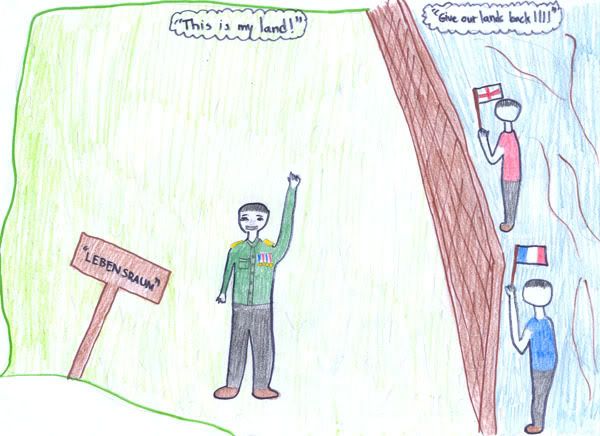
WWII Causes Cartoon: Hitler's Expansionist Policy (From Britain & France View)

For an enlarged image, please follow this link: http://i89.photobucket.com/albums/k236/phisitthep/blog_cartoon.jpg


This cartoon describes one of the causes of World War II, which is Hitler's expansionist policy. I am drawing this cartoon from the point of view of Britain and France. As we can see, one of Hitler's expansionist policies is the idea of "lebensraum", which basically means living space. From Britain and France's point of view, we can say that this living space is taking away free land from the countries that are not in control of Germany at that time. According to the information, it says that Hitler believed the living space that he needed for German population in the future would be captured from other parts of Europe, especially the on east (and including the Soviet Union). As in the cartoon, it is like making a wall to draw a new border around an area of land. People on the other side would be complaining to get their lands back. Therefore, when people's lands are taken away, more tensions built up and it is what led to the outbreak of World War II.

Sunday, January 13, 2008

Sir Winston Churchill (By Oak and Cash)


Sir Winston Churchill is the greatest British political figure and a national hero during World War I and II. His father, Lord Randolph Churchill was a politician as well. At young, he studied at Harrow and Sandhurst and was at the very bottom of class. After he was graduated, his career was inconstantly. His first job was a reporter. He was working for the London Daily Graphic. Then during 1896 to 1897, Churchill became both soldier and journalist in India. In 1900, he was elected to the parliament. Then in 1908, he married an American wife, and got one son and three daughters. As World War I broke out, Churchill had helped in developing weapons, especially the tank. He also helped the British’s fleet to prepare in war. However, his fight in Dardanelles was failed, and so it made his reputation decrease. Also, after World War I, he was against the policy of appeasement, believing that it would bring harm to Britain. People still did not want war to occur, so Churchill still was not famous. As the war broke out in September 1939, people then realized that Churchill was right and his famous had increased. His reputation continued to increase during World War II.

There were some contributions that Sir Winston Churchill had made before and during World War II. Before World War II broke out, Neville Chamberlain had made an agreement at Munich, known as the Munich Agreement, with Adolf Hitler saying that Britain and Germany would never go to war again. They agreed to work out any future differences by negotiation and Hitler informed Chamberlain that he had “no further territorial demands.” As a lot of people were relieved with these words, Winston Churchill stood up and voiced disapproval. Churchill believed that signing the agreement with Hitler was the worst course of action that could have been taken. It was true that Hitler had got his way with Czechoslovakia, but it was no guarantee against the threat of future aggression from Germany. He recognized that Hitler could not be trusted and that appeasing him was not a long-term solution to keeping the peace. However, as most people were determined to avoid war, Churchill did not become popular. When the war broke out later in 1939, it appeared that Churchill was right. Then, on May 10, 1940, King George VI asked him to become Prime Minister. In his first speeches as Prime Minister, he usually tells the people “I have nothing left to offer but blood, toil, and tears.” During the war, he gave a lot of speeches to make the British keep confidence. His words and signs help the British going in their darkest hour. One of his greatest achievements was to stand up as a strong opponent to any negotiations with Germany throughout the war. He also made relationships with other countries like the United States and the Soviet Union. Finally when the war ended in 1945 with Germany surrendered, it has been proved that Churchill had been a great wartime leader. But later, the British people wanted new changes in the government. There was a general election and Churchill was replaced by a new Prime Minister, Clement Attlee.

According to our opinions, we can see how Sir Winston Churchill had helped Britain go through the war after he was unsuccessful in warning the people before the war would break out. During the war, his job as a leader was to keep the spirits of the people and the army up. This was important because without someone to give hope, the people would be in a bad state and would be scare to do anything, especially defend themselves when being attacked. Another important role was his relationships with foreign countries. This was also important because it gave confident to those countries that there is someone ready to help when in need. Those countries would also help Britain too, because of the alliance system, and another reason was because of Churchill’s reliable speeches. We believe that Sir Winston Churchill was one of the greatest leaders of Britain during the time of World War II and later after the war. This is why we call him an important person of World War II.

- By Oak and Cash

Sources

1) "Sir Winston Churchill biography.” echeat. 12 Jan 2008. [http://www.echeat.com/essay.php?t=25660]

2) "Winston Churchill." Churchill Biography. PANTAS PROJECT PHILIPPINES. 12 Jan 2008. [http://pantas.ph/lit-elib/churchill.html]

3) "Winston Churchill.” Wikipedia. 13 Jan 2008. [http://en.wikipedia.org/wiki/Winston_Churchill]

4) "Kelly, Niger, and Paul Shuter. Sir Winston Churchill (1874-1965). 13 Jan 2008. Singapore: Pearson Education, 2004.
Monday, November 5, 2007

Introduction

Today, we see different types of media around us. It can be posters, radios, television, newspapers, fliers, brochures, and a lot more. These different types of media tell us something; they are trying to give us information or tell us about something. Propaganda is a similar word according to the previous explanation. Propaganda is defined as a set of messages aimed at influencing the opinions or behavior of large numbers of people. As we can see, during the period of the Russian Revolution, Stalin had used propaganda to make him famous and well-known to the people of the Soviet Union. He proclaimed himself and made other people believe that he is god. Different schools during that time had taught this idea and brought this idea to be known until today.

"Propaganda". Wikipedia. Wikipedia. 5 November 2007. [http://en.wikipedia.org/Propaganda]

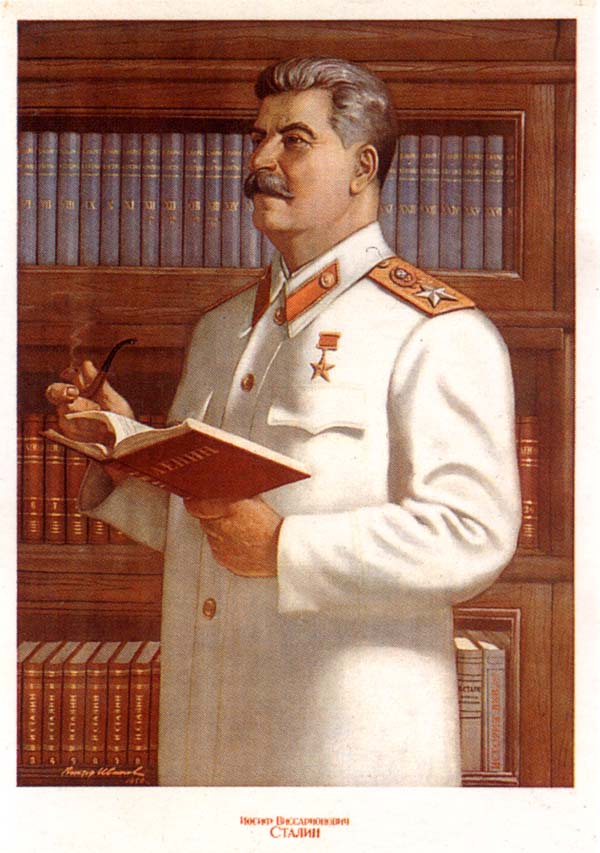
Poster 1

"Dear Stalin, Happiness of People." Online image. Old USSR Posters about Stalin and Soviet People. 5 November. 2007. [http://www.internetvibes.net/wp-content/gallery/stalin-posters/poster27.jpg]

The message of this poster says "Dear Stalin, happiness of people". It is trying to say that Stalin could do anything to make people happy. In the picture, we can see that Stalin looks neat and professional in the picture. By himself holding a book, we might think that he looks like a philosopher. We can also see something like a library at the back of him. It looks as if Stalin was highly educated and is able to lead the Soviet Union. It might be effective because this poster does not involve the country (other posters have backgrounds as the army, soldiers, etc.), so people will believe that Stalin can use his knowledge instead of power to take care of the country.

Poster 2

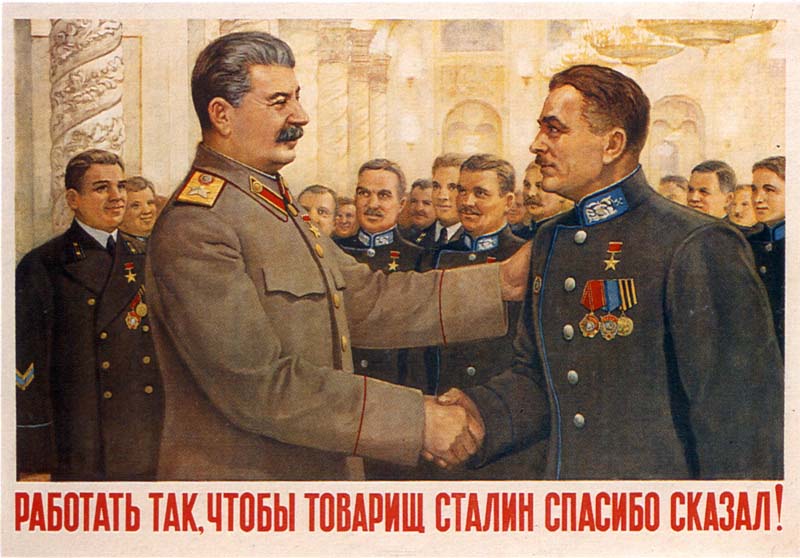
"I'm Looking Forward for New Ideas." Online image. Old USSR Posters about Stalin and Soviet People. 5 November. 2007. [http://www.internetvibes.net/wp-content/gallery/stalin-posters/poster05.jpg]


The message of this poster says "I'm looking forward for new ideas". This is showing that Stalin has contact with other leaders and as the quote says, he is trying to look forward for new ideas. Some people who sees this might think that Stalin is a smart and friendly leader, since he might have conferences or be in contact with other leaders. We can see in the poster that there is Stalin shaking hands with someone else, and with some other executives standing in the background. This poster might be effective because people can see it as an international detail. People from other countries might also see this poster too, and think that Stalin is also a good leader. However, they do not know what conflicts are going on inside the country.

Poster 3

"Glory to Stalin the Great." Online image. Old USSR Posters about Stalin and Soviet People. 5 November. 2007. [http://www.internetvibes.net/wp-content/gallery/stalin-posters/poster09.jpg]


This poster says "Glory to Stalin the Great!". It is trying to tell that Stalin is the greatest leader of the Soviet Union. We can see that Stalin is wearing his uniform and shows that he is a brave and decisive leader. Also, it looks as if he is touching his heart, so it means that he is loyal to his country. If it is effective or not, it depends on the people's view. Some might say that he is just showing off in his uniform, and also with the army at the back of him. Others might say that he looks brave and a good leader, with that cool look on his face.